A new generation of American airpower just landed on China’s doorstep, and it is built to stay.
Story Snapshot
- Two F-15EX Eagle II fighters have arrived at Kadena Air Base for hands-on training with local units ahead of permanent deployment.
- The visits in 2025 and 2026 are stepping stones toward basing 36 F-15EX jets at Kadena, restoring heavy fighter power in the Indo-Pacific.
- These flights strengthen U.S. deterrence near Taiwan and the East China Sea while China races to grow its own air forces.
- Despite production delays, the Trump administration is moving to keep U.S. air dominance and protect allies without backing down to Beijing.
Newest Eagle Lands in China’s Backyard
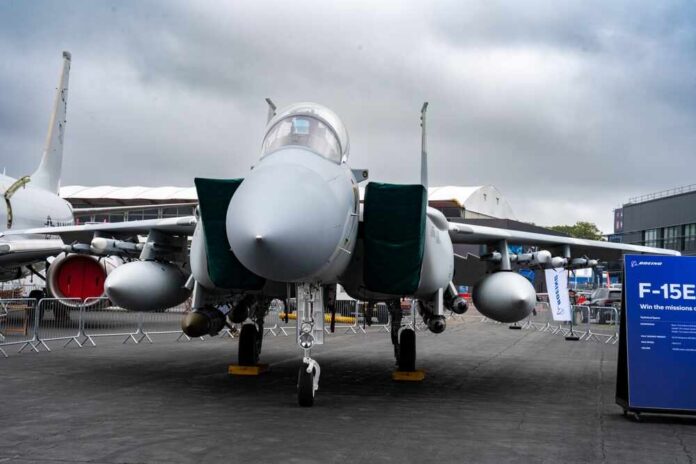
Two U.S. Air Force F-15EX Eagle II fighters from the 85th Test and Evaluation Squadron first landed at Kadena Air Base in Okinawa on July 12, 2025, for integration and familiarization training with local units and partners. The 18th Wing’s public affairs office called the visit “a key milestone” in modernizing American airpower in the Indo-Pacific and preparing Kadena’s personnel for the arrival and future sustainment of the F-15EX fleet. These jets flew from Eglin Air Force Base in Florida, arriving with other fighters so pilots and maintainers could practice real-world operations in the same contested region they are expected to defend.
Trump administration defense planners and Pacific commanders are using these deployments to rebuild forward combat power after the phase-out of older F-15C and F-15D Eagles from Kadena. The Pentagon’s plan is to replace those aging aircraft with 36 F-15EX Eagle II fighters, giving the base fewer jets on paper but more punch thanks to modern sensors and far greater weapons capacity. By operating the new fighters from their “future home station,” Air Force leaders say they can refine tactics, maintenance routines, and logistics chains before the aircraft arrive for good, helping ensure constant readiness in a tense theater.
Training Flights That Point to a Permanent Presence
The 2025 visit was not a one-off photo op but the first phase of a larger transition to next-generation airpower in the region. In public releases, Kadena’s 18th Wing explained that integration and familiarization training gives aircrews and maintenance teams a chance to collect data and adjust support plans for long-term operations in a forward-deployed environment. Army Recognition, citing Defense Visual Information Distribution Service material, reported that the deployments are meant to help pilots, maintainers, planners, and partner forces learn how the F-15EX will fit into Kadena’s future combat structure, from air defense to strike planning and base support.
A follow-on deployment in late June 2026 brought an F-15EX Eagle II back to Kadena along with F-15E Strike Eagle aircraft, again from the 85th Test and Evaluation Squadron. Airmen across the 18th Wing used that rotation to strengthen coordination between operations, maintenance, and mission support units while validating maintenance procedures and logistics needs for F-15EX operations. This “crawl, walk, run” approach matches how the Air Force has introduced other advanced fighters to overseas bases, spacing visits over months and years as the service balances budgets, production schedules, and regional threats.
Why Washington Is Sending Eagles, Not Just Stealth Jets
The Boeing F-15EX Eagle II is based on the proven F-15E Strike Eagle but adds digital flight controls, advanced radar, and an open mission systems architecture that allows rapid upgrades. The aircraft can carry a very large weapons load, including long-range air-to-air missiles and standoff munitions, giving it a different kind of power than stealth platforms like the F-35. A National Defense Strategy focus on China and Russia pushed the Pentagon to field this upgraded Eagle as a “weapons truck” that can work with stealth fighters, drones, and other assets to overwhelm hostile air defenses while still defending friendly skies.
For conservative readers worried that past administrations weakened American deterrence, these moves mark a clear shift back toward strength. The Department of Defense has said Kadena will receive 36 F-15EX aircraft, while Misawa Air Base in northern Japan transitions from F-16 fighters to 48 F-35A stealth jets. Analysts describe the Kadena plan not as simple one-for-one replacement, but as restoring permanent heavy fighter capability at one of America’s most critical forward bases near Taiwan and the East China Sea. That permanent presence matters when China is expanding its own air fleet and building hardened airfields aimed at pushing U.S. forces farther away.
Delays, Labor Strikes, and Staying the Course
Not everything has gone smoothly. A labor strike at Boeing’s St. Louis plant from August to November 2025 disrupted production and delayed the first F-15EX deliveries to Kadena by roughly fourteen months. Air Force officials said the service would continue to support Kadena’s mission with rotational forces until the new jets arrive, leaning on existing fourth and fifth-generation fighters to fill any gap. Later testimony from Air Force leaders suggested the first permanent F-15EX aircraft may not reach Okinawa until 2027, with the full fleet arriving by 2028.
Modernizing the skies ⚡️✈️
A U.S. Air Force F-15EX Eagle II and F-15E Strike Eagles assigned to the 85th Test and Evaluation Squadron travel to Kadena Air Base, Japan, for integration and familiarization training with local units and joint partners.
📍 Japan
📸 Staff Sgt. Dwane… pic.twitter.com/pBUzTzkofM— U.S. Pacific Command (@USPACOM) June 30, 2026
For a Trump-supporting audience that has seen promises broken before, this mix of progress and delay raises fair questions about defense industry reliability and procurement red tape. Still, despite union strikes and contractor schedule slips, the broader trend is clear: the United States is moving modern combat power closer to China, not pulling back. Each training rotation gives Kadena’s airmen more time with the Eagle II, sharper tactics, and a stronger ability to respond fast if Beijing miscalculates. In plain terms, the administration is investing in hard power, not slogans, to keep the peace through strength.
Sources:
19fortyfive.com, theaviationist.com, dvidshub.net, usafe.af.mil, facebook.com, airandspaceforces.com, af.mil, armyrecognition.com, instagram.com